
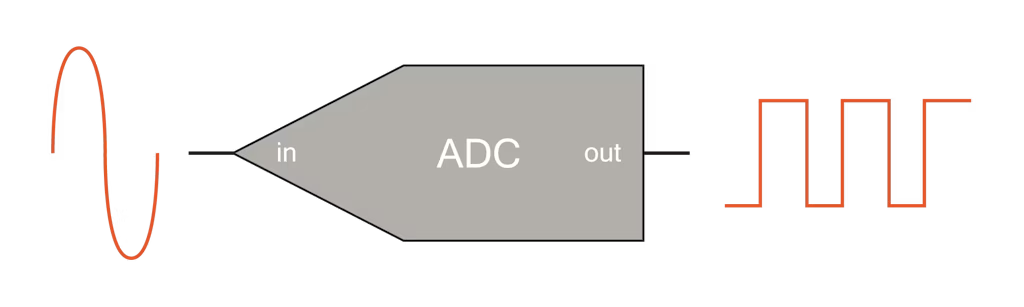
Digital technology has largely overtaken analog systems due to its superior ability to distinguish signals from noise. While this has been previously demonstrated with examples, the specific reasons behind this capability deserve further exploration. Let’s consider a phone-to-phone conversation to illustrate this concept. When you speak into a phone, your voice generates analog sound waves, which are captured by a microphone. These analog signals are then processed through an analog-to-digital converter (ADC), which measures the number of electrons at specific intervals and translates the wave into numerical values. Once transmitted, the signal passes through a digital-to-analog converter (DAC) at the receiving end, converting it back into an analog format for playback through the speaker.
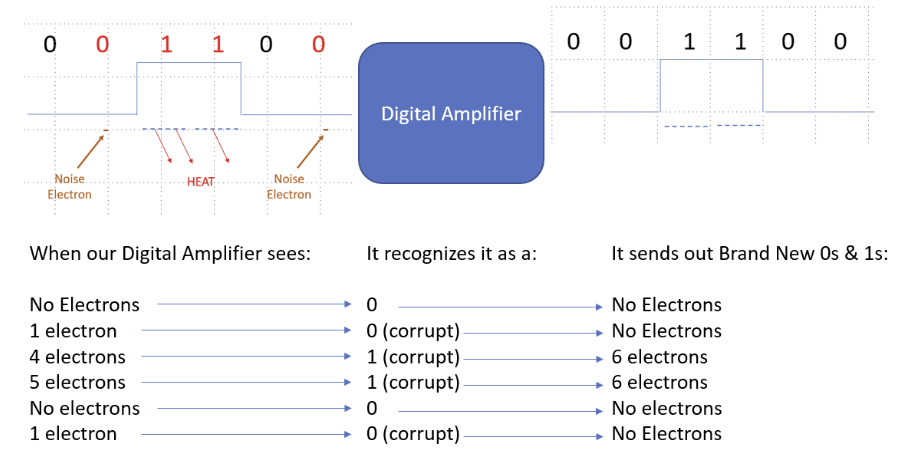
One challenge in this process is differentiating between values that are very close to each other. To overcome this, binary code was invented. Binary represents data using only 1s and 0s, where each binary digit (or bit) functions as the smallest unit of information. Eight bits combine to form a byte, which can represent more complex data. Micro-transistors, acting like tiny switches, generate these binary values by toggling between on (1) and off (0) states. To ensure signal clarity, a digital amplifier is used to clean up and restore corrupted signals, particularly when values become distorted or hard to distinguish. Without digital amplifiers, modern technologies such as computers and the internet would not be possible.
This post was spelling and grammar checked using chatGPT 4o (paid version).